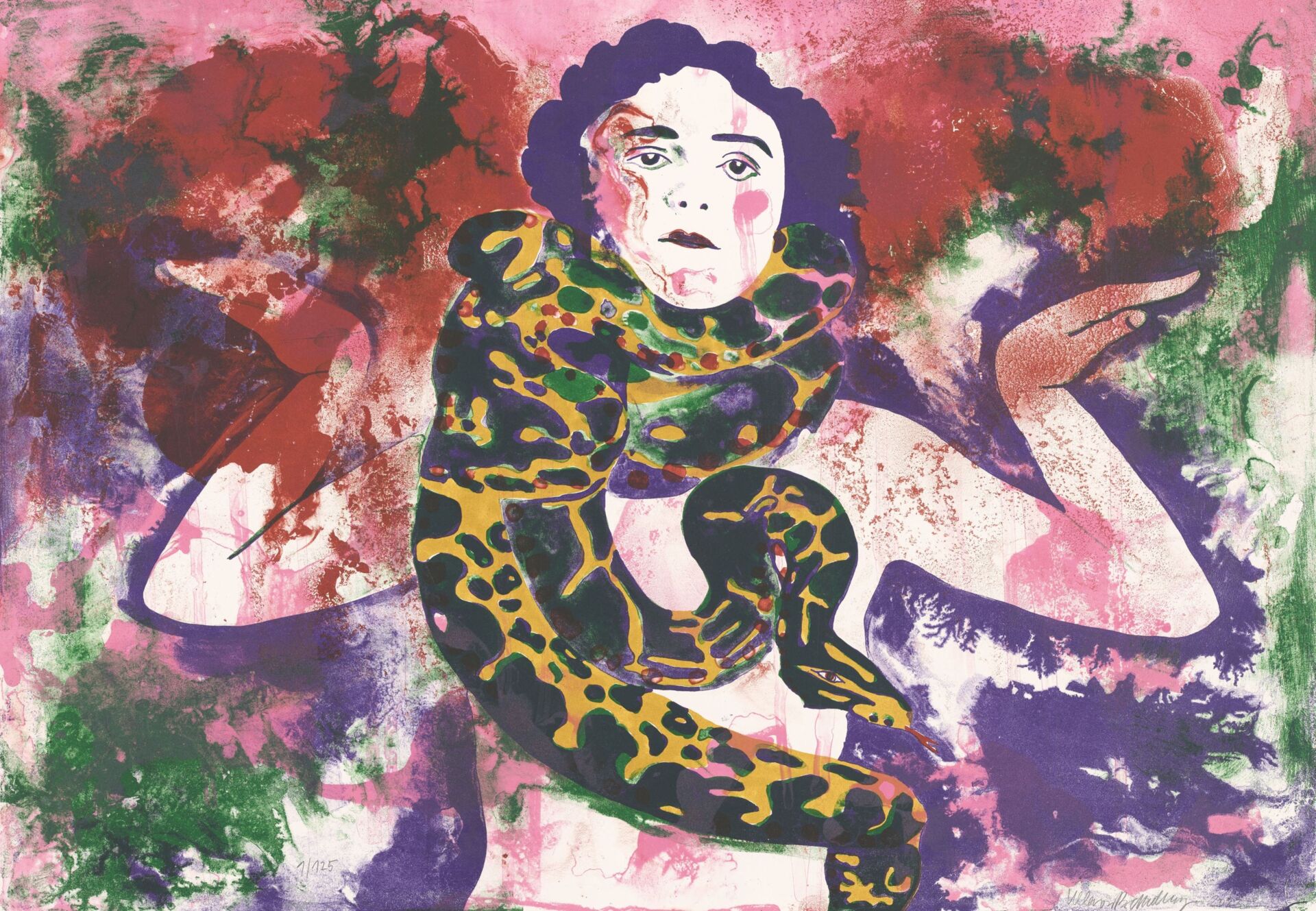
Boundless printmaking
The Schweizerische Graphische Gesellschaft
With Boundless printmaking. The Schweizerische Graphische Gesellschaft, the Kunstmuseum Basel draws from the holdings of the Kupferstichkabinett (Department of Prints and Drawings) to present highlights of the prints commissioned by the Schweizerische Graphische Gesellschaft (SGG). The 34 works on display were created between 1917 and 2026 and showcase a remarkable range of artistic styles, printmaking techniques, and thematic concerns across this period. Featured artists include Omar Ba (*1977), Alice Bailly (1872–1938), Eduardo Chillida (1924–2002), Paul Klee (1879–1940), Meret Oppenheim (1913–1985), and Shirana Shahbazi (*1974).
Around 1900, an increasing numbers of artists began to embrace printmaking as an independent artistic medium rather than merely a means of reproducing paintings. The works produced in this way became known as original prints. Simultaneously, collectors and museums recognized the need to actively support contemporary printmaking and artists.
In response to this growing interest, the SGG was founded in 1918. Since then, it has promoted the graphic arts by commissioning artists to create original prints. Today, the SGG's 125 members include both Swiss and international museums as well as private collectors. Each member receives one impression of every edition, accompanied by information about the work’s technique and subject matter. At least two editions are distributed each year.
The SGG's first president Paul Ganz (1872–1954), also served as director of the Kunstmuseum (back then called curator of the Öffentliche Kunstsammlung Basel, the public art collection of Basel) at the time. Therefore, the museum has the honor to receive the very first impression of each edition. The artists selected for commissions are chosen through a democratic process at the SGG's general assembly.
The 278 editions produced since the SGG's founding have continually redefined the boundaries of printmaking. Artists experiment with new printing techniques, explore innovative forms of visual expression, and use prints as a platform to address issues such as culture of remembrance, emancipation, and social responsibility.