Cao Fei

Testimonies to the Near Future

GEGENWART / 30.05.–11.10.2026 / Curated by Stephanie Seidel, Philipp Selzer, Alice Wilke

The Chinese artist Cao Fei (b. 1978, Guangzhou, lives in Beijing) is one of the defining voices of her generation, working across video, digital media, photography, installation, and sculpture. The artist’s works capture the rapid changes that have shaped China, and the Pearl River Delta in particular, since the country’s 1978 policy of Reform and Opening up.

For Cao Fei. Testimonies to the Near Future, her first solo exhibition in Switzerland and largest survey exhibition in Europe to date, the artist transforms the Kunstmuseum Basel | Gegenwart into a total work of art that takes the form of a city blending immersive installations and video universes from her oeuvre of the past thirty years. Cao Fei’s achievement as a pioneering creator of digital worlds is uncontested. Her early works have influenced an entire generation of artists from Asia and beyond. For over two decades, she has made art—from video installations and digital simulations to virtual-reality settings—grappling with the impact on human life of wrenching societal and technological transformations, establishing her renown as a leading thinker about art, media, technology, and the future.

Her videos and partly game-based environments are situated in factories, dreamscapes, and visions of a future. Exploring aspects of work, change, and the peculiar beauty of a globalized world, they address questions of identity, embodiment, and recollection. Cao Fei examines how economic growth, technological development, and globalization influence our society, without ever descending into pessimism about the future. Among the centerpieces of the exhibition at the Kunstmuseum Basel | Gegenwart are seminal works like Whose Utopia (2006), RMB City (2007–), Asia One (2018), Nova (2019–), Oz (2022), and the Hip Hop series (2003–).

Perhaps the most remarkable feature of Cao Fei’s art is her gift for integrating speculative and surreal elements into works that are often almost documentary. This
aspect is underscored by elaborate installations that materialize elements from the videos in the exhibition space, further blurring the boundary between the physical and virtual realms.

The exhibition, which extends across all four floors of the Gegenwart building, invites viewers to delve deep into Cao Fei’s extensive oeuvre and makes for a singular experience in three dimensions in which the video works are not just on display but become an immersive reality.

The exhibition is designed by Cao Fei in collaboration with Small Production, Beijing.

Places in the Exhibition

The Street

HIP HOP: Guangzhou; Fukuoka; New York; Hong Kong; Sydney; Shanghai (2003-2025)
The HIP HOP project seeks to connect hip-hop with different cultures and invites everyone—not only the young—to interpret hip-hop through their bodies, to experience it physically, and to find a sense of release within it, thereby revealing the true contours of a city. — Cao Fei

The multi-part series presented here is inspired by Cao Fei’s passion for hip-hop culture—an important influence in her early engagement with popular culture, the videos are shaped by both Cantonese pop music and American rap. Her short, dynamic videos reflect the reinterpretation of African American cultural forms in urban settings across China, Japan, the United States, and Australia. In doing so, Cao Fei highlights the hybrid nature of contemporary global culture. Filming in different cities, she captures people from everyday life dancing to hip-hop in public spaces.

At the same time, Cao Fei draws on the technique of sampling—a practice central to hip-hop—in which diverse sonic elements from different origins are combined to create something new. The videos shot in New York and Sydney focus in particular on members of the Chinese diaspora (communities living outside their country of origin), capturing their distinctive energy and rebellious spirit.

Close
The Park

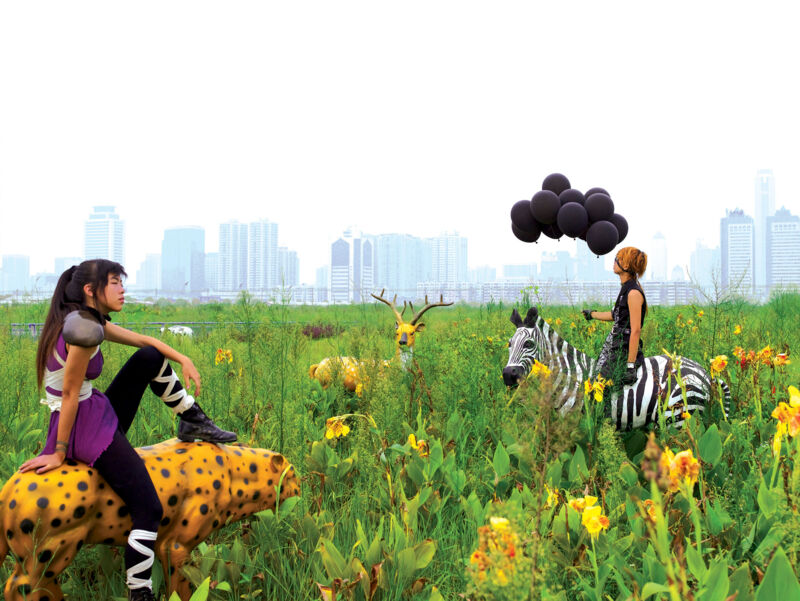
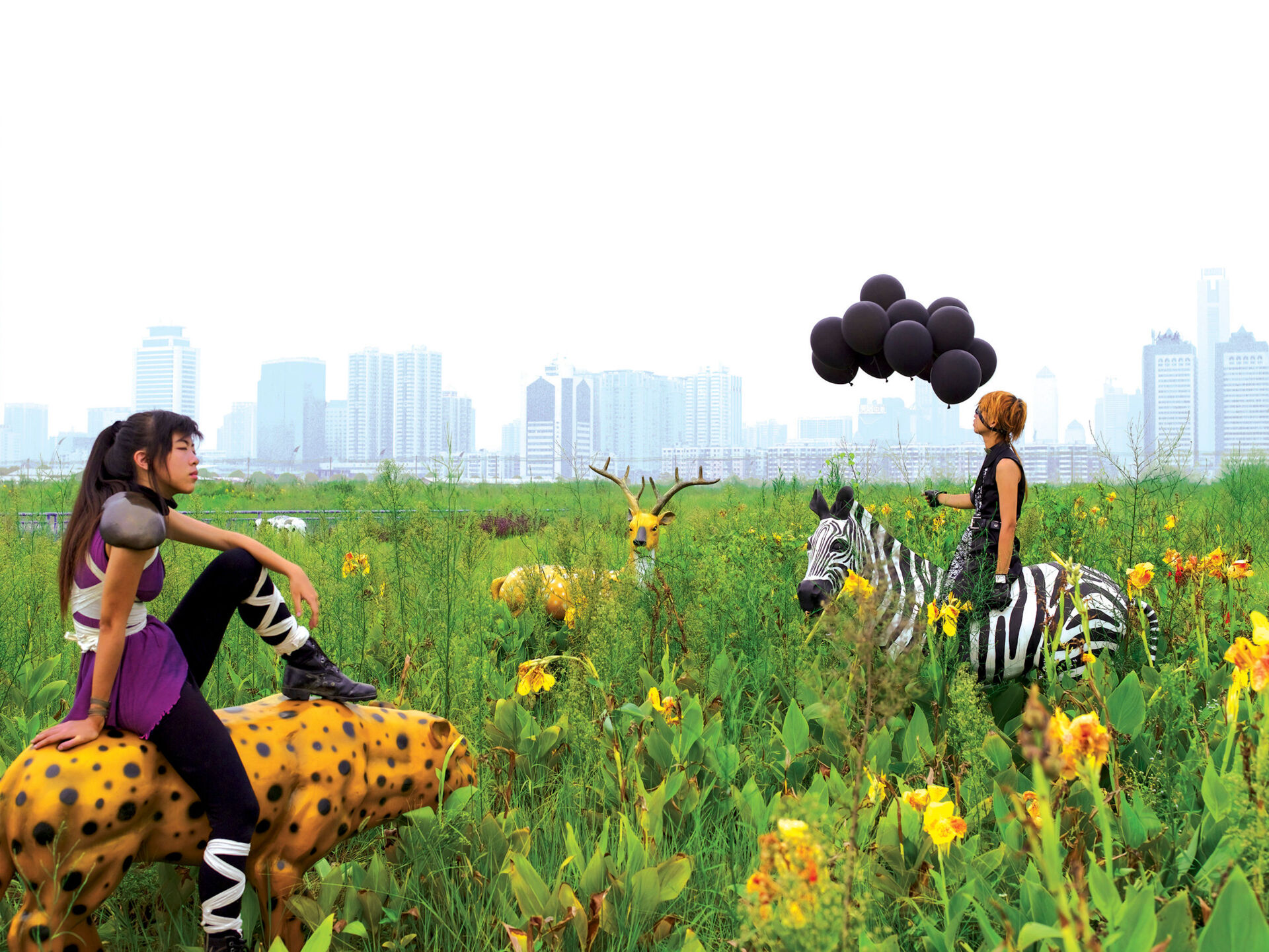
Cosplayers (2004)
The video captures the playful seriousness of a generation of youth that grew up with comic literature and online gaming platforms. With Cosplayers Cao Fei explores how online youth culture is reflected and extended into physical space. Cosplay (costume and play) is considered a subculture with a large and dedicated following, which originated in Japan in the 1970s.

On the outskirts of the Chinese megacity of Guangzhou, Cao Fei filmed so-called cosplayers—a group of young people, who dress up as their idols from manga, films, and video games and reenact these characters with great attention to detail. By stepping into these roles, they create their own reality within the fabric of everyday life. In Cao Fei’s video, the protagonists wander through the streets of the metropolis, posing among construction sites and half-finished villas. In images tinged with a sense of the surreal, Cao Fei portrays the cosplayers in their elaborate costumes.

Cosplayers can be understood as a tribute to self-determination, as these young people carve out spaces of possibility within existing structures. At the same time, the work reflects on the cost of rapid urban development: existing landscapes and open spaces disappear. The meadow where cosplayers once released black balloons into the air is now part of Zhujiang New Town—a vast business district of luxury apartments and skyscrapers.

Close
The Factories

11.11 (2018)
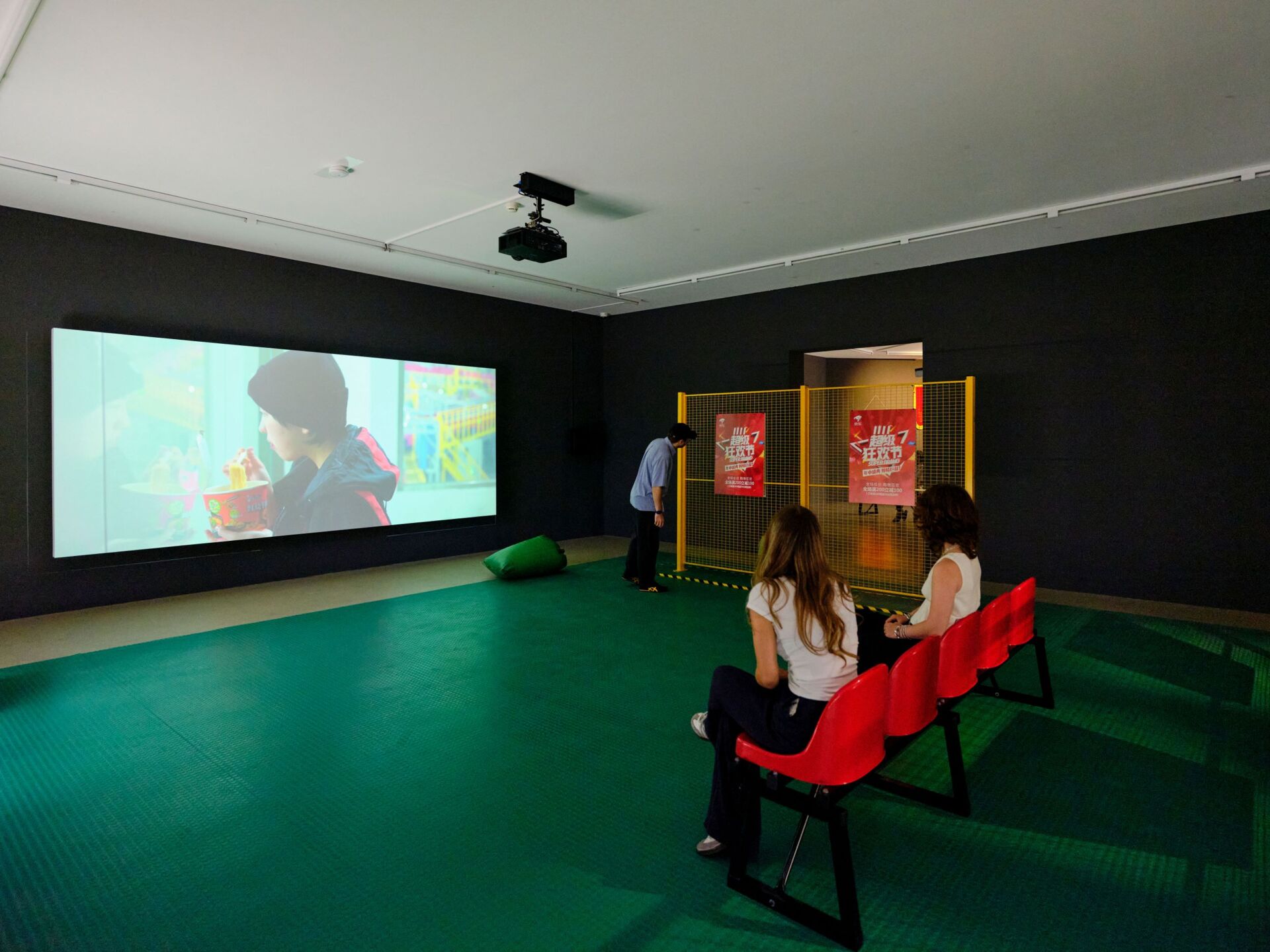
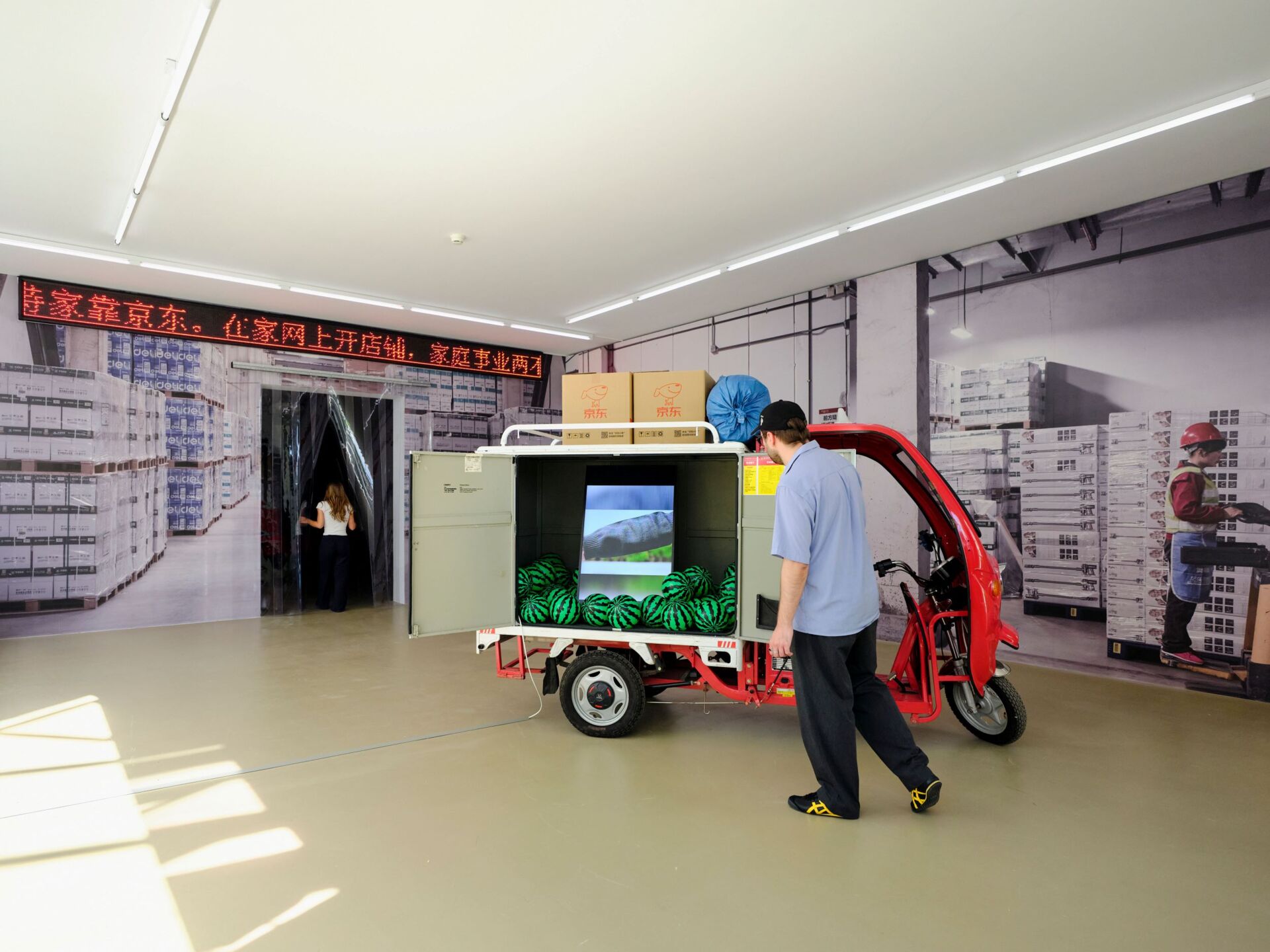
The title refers to the annual event in China that takes place on November 11 and that is considered the largest online shopping festival in the world. Cao Fei’s documentary turns its attention to the working conditions behind the supposed magic of online commerce, tracing the operations of the logistics company Jingdong Logistics around this date. The focus lies on distribution centers on the outskirts of Beijing, the company’s headquarters, as well as the numerous delivery stations spread across the city’s business districts and traditional neighborhoods.

The film reveals the intense workload placed on the entire logistics apparatus—before, during, and after the “Double Eleven” shopping day. Cao Fei follows and interviews delivery workers who transport goods of all kinds to every corner of Beijing, from modern apartment complexes to buildings in older parts of the city, most of which are serviced by motorized tricycles. Through tracking shots across the city, the film makes visible the connection between the immense time pressure experienced by couriers and the patterns of consumption that further fuel the growing demand for such services. In doing so, Cao Fei paints a multifaceted picture of consumer culture and the vast scale of service chains operating at full capacity.

Asia One (2018)
The film is set in the first fully automated distribution center in Kunshan, Jiangsu Province, near Shanghai. It features two human workers, and an artificial intelligence robot employed in this hightech logistics facility, the Asia One Unmanned Warehouse.

The film centers on the relationship between the two employees, shaped by long periods of solitude and the monotony of their tasks. Within an environment defined by surveillance and mechanical precision, they seem to have lost their sense of interpersonal communication—appearing estranged from one another, as well as from the goods they handle.

At one point, however, the vast automated sorting system falters, disrupting the film’s space-time continuum: a group of workers suddenly appears in costume, dancing to disco music beneath a banner reading “ Humans and Machines, Hand in Hand.” The colors and choreography evoke the aesthetic of model operas from the Cultural Revolution (1966–1976).

With Asia One, Cao Fei reflects on China’s transformation from an industrial production site into a global leader in advanced technologies and digital solutions—while also addressing the growing distance between people and their work that accompanies this technological shift.

Whose Utopia (2006)
The video was created in close collaboration with employees of the Osram light bulb factory in Foshan, in the Pearl River Delta—a region long regarded as the center of China’s consumer goods production for the global market. People from across China migrated there to find work in the factories. Against this backdrop, the video explores the dreams and passions of factory workers.

During her six-month stay, Cao Fei documented everyday life in the factory and conducted interviews with its workers. She asked them about their hopes, visions for the future, and motivations: “Why did you leave your home? What do you expect from the future? How do you experience the factory?” These encounters developed into a participatory process extending beyond the video itself: Together they produced a newspaper, organized a singing competition titled Utopia Idol, formed a rock band, and reinterpreted the company motto TPM (Total Productive Maintenance) as “Team, People, Motivation.”

Whose Utopia condenses documentary and collaborative elements into a poetic narrative in three parts. In the second half of the video, the workers stage performances within the factory halls, between machines and workbenches: They practice tai chi, dance ballet, or play rock music. Between the poles of reality and imagination, individual longings emerge—longings that have no place within the rigidly structured system of industrial production. With Whose Utopia, Cao Fei creates a multilayered portrait of subjectivity, resilience, and dreams under the conditions of industrial labor.

Close
The Cinema

Hongxia (2019)
The Hongxia (morning glow) Theater was built in 1957 on Jiuxianqiao Road, in northeast Beijing, as a cinema and cultural center for workers from the surrounding factories. At the time, these factories formed part of one of China’s most advanced electronics districts. Between the 1950s and 1960s, key efforts toward the development of China’s first computer were undertaken here. However, the vision of an independent technological revolution gradually stalled as the initiative fell behind in international competition. With the final closure of the factory, the theater also shut its doors and remained largely untouched for years.

Between 2015 and 2020, Cao Fei transformed this forgotten site into a combination of studio and research laboratory. Over a period of five years, she developed an on-site project situated at the intersection of media archaeology, social history, and science fiction. The Hongxia Theater served as its point of departure. From here, she interwove obsolete dreams from China’s technological past with speculative visions of the future. Cao Fei describes this approach as an attempt to “destroy linear time.” In her films and documentary research, she also preserves the memories of former employees, who recall Hongxia as a social meeting place within the neighborhood. The theater thus becomes a resonant space in which individual life stories, collective history, and imagined futures overlap.

MatryoshkaVerse (2022)
MatryoshkaVerse documents life in the Chinese border city of Manzhouli in Inner Mongolia. Located at the intersection between China and Russia, the city was founded at the beginning of the 20th century and became important in the context of the New Silk Road. Launched by China in 2013, the New Silk Road initiative encompasses the expansion of extensive trade routes connecting the country with more than 100 others. From the outset, Manzhouli assumed both a strategic and symbolic role: it functioned as a trading hub between China and Russia, as well as a key node linking China and Europe. Moreover, it was intended to project the region’s economic strength outward.

At the railway station, international transport routes intersect: the Trans-Siberian Railway stops here, freight trains connect China and Europe, and passenger trains run between Beijing and Moscow. Within a short period of time, factories, residential complexes, hotels, leisure parks, and a monumental stadium were constructed. At the same time, members of the Mongolian minority continue to live on the vast grasslands outside the city in traditional tents—marking a landscape that is shaped by the coexistence of high-speed modernity and centuries-old ways of life.

Cao Fei presents Manzhouli as the site of a grand vision that has ultimately revealed itself as a mirage. Idle factories, unused commercial zones, and abandoned leisure facilities testify to unfulfilled expectations. Oversized matryoshka figures (Russian for mother—several painted wooden nesting dolls that fit one inside another), that contain hotels become striking symbols of this economic bubble. Documentary footage is intertwined with staged sequences, rendering visible the contradiction between rapid urban development and social reality.

Nova (2019)
Nova brings together science fiction and elements of a historical film. In the fictional city of Nova, an ambitious computer scientist works at a technology company on a secret mission. Together with an international research team and a Soviet scientist, he develops a novel computer platform designed to enable travel through time and space, as well as the transformation of human existence from physical into digital matter.

The scientist involves his own son in the experiment. But the attempt fails, and the boy is lost in cyberspace. He finds himself suspended in a state between data body and physical form, between dream and reality, past and future. Enclosed in a spacesuit, he traverses retro-futuristic worlds in search of a way back home.

The film unfolds slowly and non-linearly. It is set during the period of socialist construction in China—the years following the founding of the People’s Republic of China in 1949. Cao Fei draws on the aesthetics of these revolutionary decades, interweaving them with futuristic visions. The failed journey through time becomes a metaphor for a belief in technological and ideological progress that leaves behind unfinished or forgotten utopian projects.

The scientific team and the figure of the cosmonaut reappear in the subsequent installation MatryoshkaVerse (2022), linking these works into an ongoing cinematic universe in which history, speculation, and memory intertwine.

La Town (2014)
La Town presents scenes from a handcrafted miniature urban landscape filmed using stop-motion animation. The work employs this labor-intensive manual technique in which objects are brought to life through the photographing of incremental movements. Using the scale of model railways as its foundation, Cao Fei constructs a prototype of a contemporary urban society that could be situated anywhere in the world. The camera’s journey through the streets and apartments of a residential block—alluding to her earlier film Haze and Fog (2014)—first emphasizes the normality of everyday life. Yet suddenly, a catastrophe brings everything to a halt. The dialogue in Cao Fei’s video is based on the film Hiroshima, mon amour (1959), written by Marguerite Duras and directed by Alain Resnais.

In contrast to Cao Fei’s earlier works, which examine how contemporary megacities are shaped and expanded through automation, industrialization, and consumerism, the narrative of La Town develops a more dystopian vision. The luminous metropolis is transformed into a bleak ruin. The work thus marks a shift in Cao Fei’s practice: whereas RMB City (2007–2011) explored the expansion of China’s real estate market within a virtual realm, here—just a few years later—she moves from cyberspace to analog techniques, presenting a vision marked by disillusionment with economic growth and new technologies.

Haze and Fog (2014)
With Haze and Fog, Cao Fei presents her own zombie film. In Western popular culture, zombies—the living dead—have become a symbol of collective fears of evil, whereas Chinese culture does not have a comparable zombie tradition. Cao Fei therefor draws on a range of sources, including John Carpenter’s classic Hollywood horror movie The Fog (1980), the paintings of Edward Hopper (1882 1967), and video games.

In Haze and Fog, the undead are people whose souls have withered away. Eschewing the graphic violence and shock effects typical of the genre, Cao Fei films her protagonists slowly and with careful attention to detail. Rather than staging a conventional opposition between good and evil, the film reveals how the uncanny emerges from the loneliness and monotony of everyday life and gradually spreads on a collective level. Moments of beauty alternate with unease. The film’s mystical charge arises at the threshold between the visible and the invisible.

The camera’s gaze into ultra-modern living units reveals individuals who have lost the meaningful rituals of everyday life. Cao Fei focuses on a middle class enveloped—almost literally—by a haze of monotony. People are surrounded by, and dependent on, anonymous service providers such as cleaning companies, real estate agencies, delivery services, and security firms. The smog hanging over the city mirrors their isolation and restlessness.

Close
The Playground

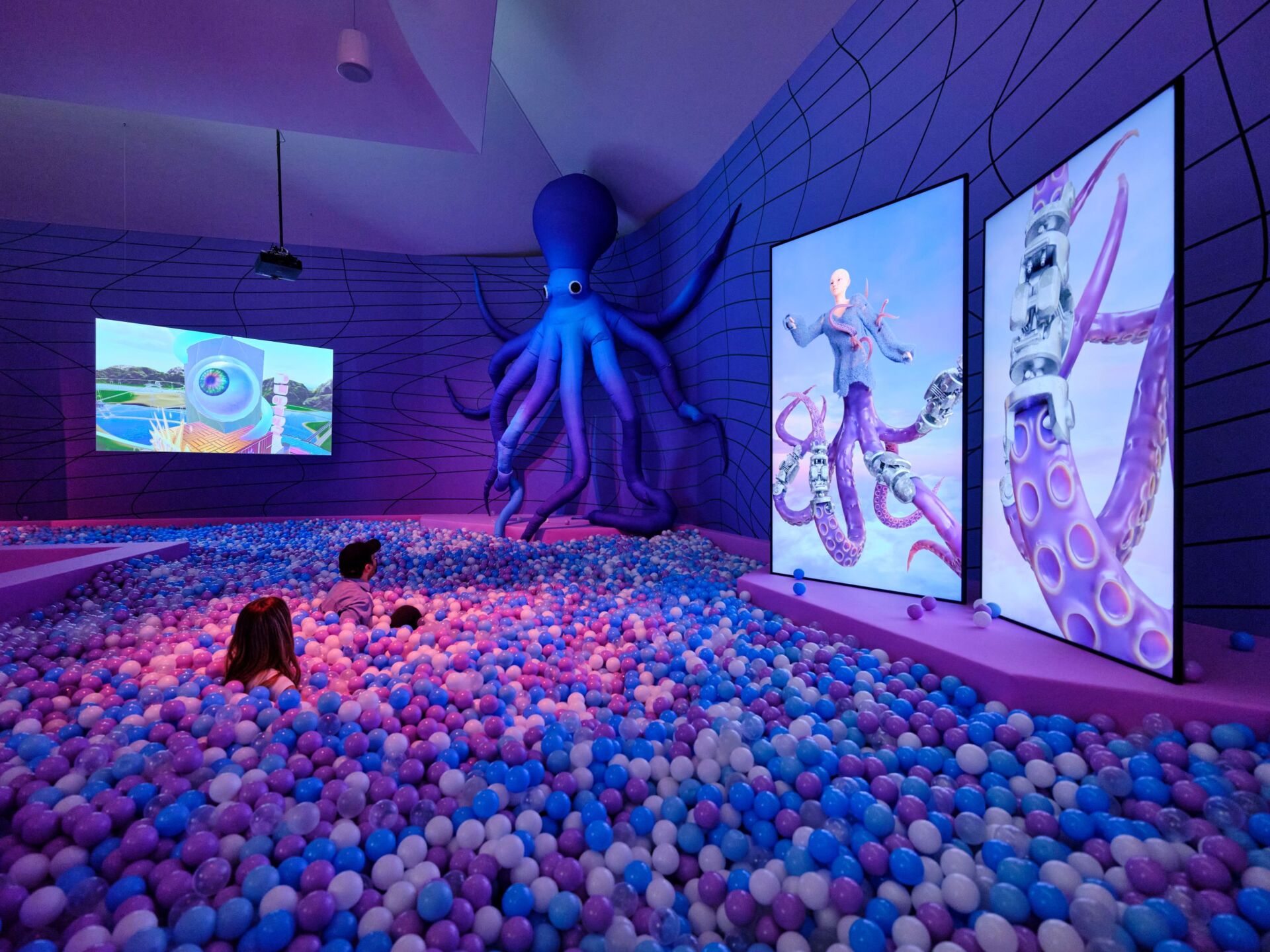
DUOTOPIA (2022, 2024) Oz (2022)
DUOTOPIA gathers the architectural spaces that Cao Fei has created within the metaverse. The metaverse is a digital, three-dimensional world on the internet, in which people move and interact as avatars. A fascinating being hovers in this boundless digital space: the avatar Oz, a figure with bionic tentacles suspended above a virtual skyline. DUOTOPIA and Oz were created by Cao Fei within Yuanbang Mega City, a Chinese metaverse platform. The term “metaverse” combines the prefix meta- (beyond) with universe. It was coined in 1992 by the American science fiction writer Neal Stephenson (b. 1959).

In DUOTOPIA, Oz appears as an androgynous, hybrid creature that transcends the boundaries between organic and technological forms, between the natural and the artificial. As an enigmatic human-machine entity, Oz marks a turning point in technological development. Unlike Cao Fei’s first avatar, the female China Tracy, her most recent avatar Oz is androgynous. With its non-human attributes and mechanical extensions, Oz stands for the integration of artificial intelligence into our society.

For Cao Fei, cyberspace is not an abstract realm detached from material reality. From her earliest works to the present, she has not understood the virtual and the physical as opposites, but rather as different layers of reality that interpenetrate and at times overlap. The video’s title “Duotopia” combines duō (Mandarin for many) with -topos (Ancient Greek for “place”), thus referring to a multiplicity of possible sites. DUOTOPIA – 1st Edition shows an upside-down, floating, metallic, technoid octopus. Its form recalls a prosthetic hand, pointing to a duality between the organic and the mechanical. From its tentacles— or fingers—emerges a network of architectural structures. Electronic sounds accompany a voice-over that recites passages from the Futurist Manifesto (1909) by Filippo Tommaso Marinetti (1876–1944). DUOTOPIA – 2nd Edition is Cao Fei’s second architectural creation within the metaverse. It is conceived as a community-based virtual urban planning and construction project within the Yuanbang app.

Meta-mentary (2022)
“I want to go to the metaverse” is the voice command entered into a navigation system at the beginning of Cao Fei’s video Meta-mentary. The title of the work combines the terms meta- (beyond) and documentary. Filmed on a mobile phone, the video is presented in vertical format. Cao Fei’s documentation of her journey to the metaverse begins in a taxi. Her destination, the metaverse, is a place where a new digital space emerges through the interplay of virtual, augmented, and physical realities. The metaverse was conceived to bring together and expand the various spheres of activity of the internet in a single, unified environment.

On her way to the metaverse, Cao Fei interviews various people she encounters by chance on the streets of Beijing and other Chinese cities. Her journey eventually leads her to the Metaverse Demonstration Mall. This virtual shopping center is located in a secluded courtyard and is accessible to members only. Cao Fei asks her interlocutors about the nature of the metaverse, its conditions, challenges, and possibilities. Their responses offer a multifaceted perspective, addressing the relationship between the analog and the digital, questions of authenticity and reproduction, as well as the boundaries and overlaps between real and virtual space.

With Meta-mentary, Cao Fei invites viewers to reflect on the impact of the digital revolution—the profound transformation of society, economy, and everyday life through digital technologies and computers since the late 20th century. How does it reshape our identity, our emotions and desires, but also our sense of community, our social relationships, and interactions?

Screen Autobiography (2023)
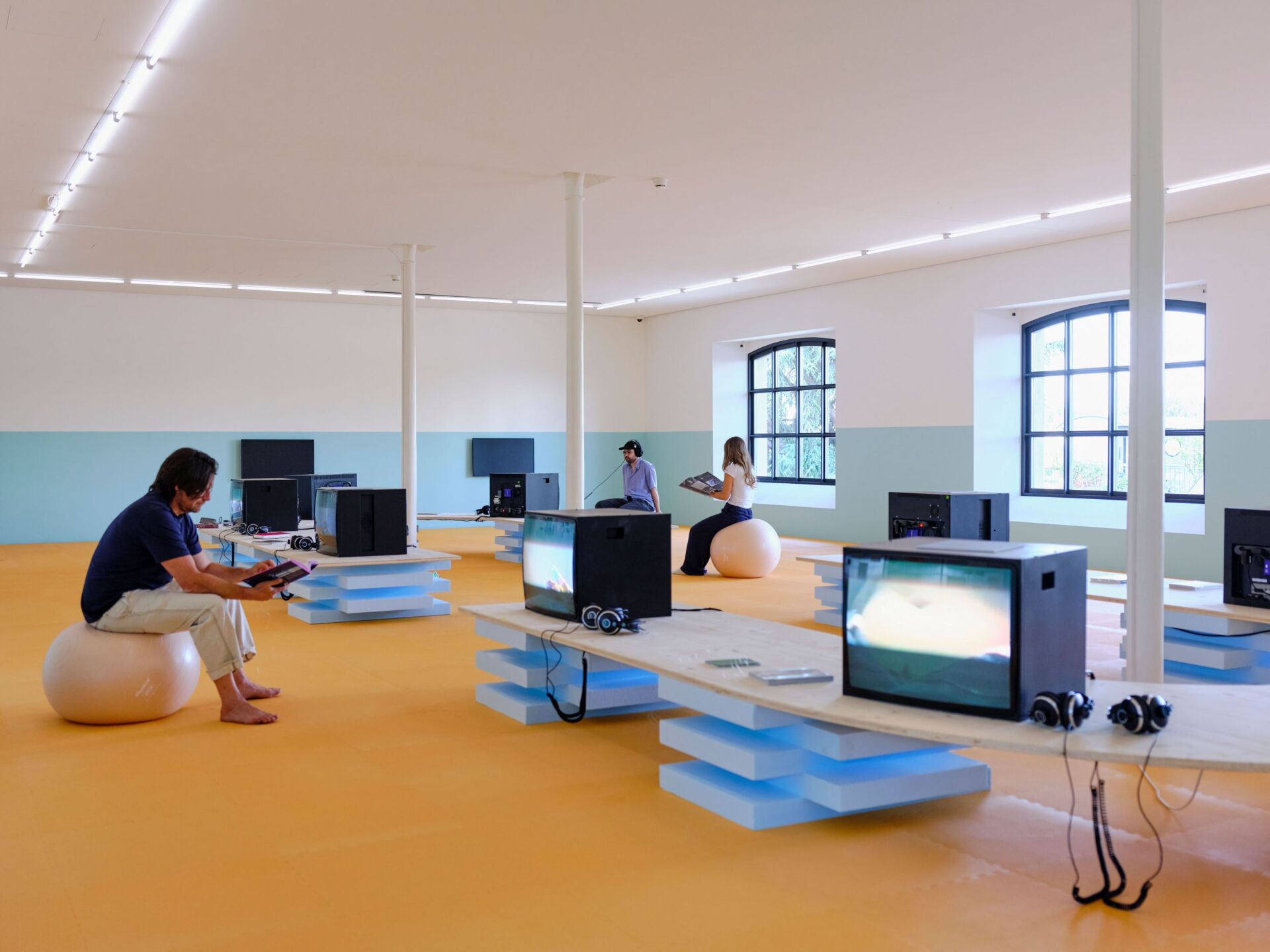
With her installation Screen Autobiography, Cao Fei translates the historical motif of the folding screen—a movable room divider—into the visual language of the digital age. The installation resembles a behind-the-scenes view of a film or photography studio: monochrome, neutralizing backdrops with the technical apparatus of image production visibly positioned in front of them. Here, the folding screen functions not only as a background and spatial divider but also, in a metaphorical sense, as an interface between virtual and physical space.

On the monitors, short videos play on a loop, themselves recorded in front of the colored backdrops. These projection surfaces— usually invisible—emerge here as framed images. The so-called screens no longer serve as neutral backgrounds but become part of the finished image.

With this work, Cao Fei reflects on the conditions of contemporary image production in relation to the culture of digital self-staging. In a present shaped by interactions mediated through displays and interfaces, and by media overlay, physical and virtual realities become intertwined. The screen both separates and connects—it is a projection surface, a filter, and a threshold. By exposing the mechanisms of image production, the artist disrupts illusion and reveals how identities are formed and mediated through screens. Thus, the folding screen—once an architectural element structuring space—becomes a digital screen, a display that not only divides space but generates its own realities.

Close
The Office

RMB City (2007–2011)
The project RMB City – A Second Life City Planning emerged at a time of optimism and a spirit of exploration, driven by the increasing dissemination and accessibility of newly developing technologies and virtual worlds. Between 2007 and 2011, Cao Fei and a team of coders and programmers in Beijing constructed RMB City, a virtual Chinese metropolis on the once-popular online platform Second Life, where users could interact within shared digital environments.

The name RMB refers to the Chinese currency Renminbi; the title can thus be translated as city of money. Cao Fei’s virtual city featured its own economic system, a manifesto, and even a mayor: Together with RMB City, she created her first avatar, China Tracy— a cyber mother and cyber leader who appeared in digital talk shows, conducted virtual feng shui sessions, and auctioned digital land to buyers from the real world. For Cao Fei, Second Life offered the possibility to construct a digital counterpart to the rapid urban development she was witnessing firsthand during a period of intense growth. With RMB City, she developed a condensed, digital vision of the global real estate market, with its cycles of boom and bust. In doing so, she addressed the close interrelation between art, technology, and economy.

Today, the RMB City project is considered a milestone of early virtual art. Originally conceived as a vibrant, interactive environment, the work now exists as a digital archive—accessible through an archived flight over the original city, as well as through a series of videos.

i.Mirror (2007)
In i.Mirror, Cao Fei’s avatar China Tracy moves through the virtual world of Second Life, documenting encounters with other users. Avatars are digital identities that represent people in virtual environments and in communication with others, appearing as images, symbols, two-dimensional graphics, or realistic renderings. Second Life is a user-generated online community—a virtual
world that has existed since 2003.

With an almost philosophical attitude, Cao Fei, aka China Tracy, questions the virtual world she inhabits: Why is it the way it is? What rules structure it—and who designs them? China Tracy encounters the seemingly young Hug Yue. Only in the course of their conversations does it become clear that behind the avatar is a 64-year-old American man. In cyberspace, identities are not bound to the biological body. Age, gender, origin, and appearance can be chosen, altered, or masked. Images and conversations do not appear merely as simulations, but as genuine exchanges of experience. Emotions and feelings emerge despite the virtual setting—mediated by the people behind the avatars. The virtual encounter between China Tracy and Hug Yue develops into a dialogue about life, identity, and personal experience— both within and beyond the digital space. The two speak openly about their desires, their biographies, and the freedoms that the digital world offers them.

i.Mirror thus reflects a frequently voiced concern—that virtual worlds might displace reality—while offering a different perspective: closeness and connection can also emerge through virtual communication. Cao Fei understands cyberspace as an expanded field of experience, in which fundamental questions of freedom, identity, and community can be renegotiated. At the same time, her exchange reveals that core human longings persist.

Rumba II: Nomad (2015)
The video addresses the consequences of growth and gentrification in China—a rapid process of transformation driven by ongoing rural-to-urban migration toward economically attractive megacities. As urban boundaries continue to expand, a phenomenon observable in numerous Chinese metropolises, this growth is accompanied by profound social and spatial upheavals.

Cao Fei filmed Rumba II: Nomad in Xiaochenge Zhuang, Beijing, in an environment that was being entirely demolished in the course of urbanization processes. Traditional single-story brick houses—remnants of long-established neighborhoods—give way to standardized new housing developments. Amid the demolition sites, people search for reusable building materials, for remnants of a disappearing everyday architecture. Within this setting, small robotic vacuum cleaners move through the ruins in circular, almost choreographed patterns. Relentlessly, they sweep up ash and dust. The robots appear both absurd and uncanny: as symbols of a present in which even acts of cleaning and remembering seem to have become automated.

Cao Fei combines documentary observation with poetic, almost comical visual elements—such as the dance of chickens perched on the robots, which lends the real demolition site the appearance of a carefully staged scene. In this way, surreal images of modernization and its tangible consequences emerge. Rumba II: Nomad presents transformation as a state of constant motion, in which places, identities, and ways of life are experienced in their temporality and fragility.

Close
The Shelter

Isle of Instability (2020–2023)
The video installation revolves around everyday life in Singapore, where the artist and her family lived for a period during the COVID-19 pandemic. Cao Fei draws on observations from her immediate surroundings. The works reflect how people in the metropolis adapted to changing circumstances, while also portraying the botanical garden as a place of refuge. Through intimate, poetic images, the artist condenses the private into a shared memory of a time marked by global uncertainty—while also showing how imagination and play can open up new spaces.

Commissioned in 2020 by Audemars Piguet Contemporary, the video installation Isle of Instability (2020–2023) features footage of Cao Fei’s daughter playfully escaping the monotony of everyday life shaped by social restrictions during the pandemic. The child’s imagination becomes a means of countering isolation and standstill. The domestic interior is transformed into a distant place, where the girl immerses herself into her own world. With just a few toys and everyday objects, she invents a story, turning them into props for her journey. While the outside world is defined by uncertainty and constraint, play creates a space of freedom and self-determination. The so-called Isle of Instability is therefore not a physical location, but a state between confinement and freedom, between reality and imagination.

Artists Archive (1995–2005)
The works presented here, created between 1995 and 2005, offer insight into the beginnings of Cao Fei’s artistic practice. From an early stage, her interest in collective action and social spaces is already evident. She frequently collaborates with friends, dancers, and people from her immediate environment, using video as a direct and responsive medium to capture spontaneous situations, small interventions, and choreographed movements in public space.

In Imbalance 257 (1999), Cao Fei stages a fragile constellation of bodies shaped by mutual dependence, making visible the tension between individual movement and collective structure.

In Rabid Dogs (2002), a group of young people moves through the urban environment like a loosely organized pack, transforming everyday gestures into a collective, almost choreographed performance.

These early works bring together playful improvisation and carefully constructed staging. They explore questions of community, physicality, and individual expression within shifting urban contexts. At the same time, they reveal Cao Fei’s enduring interest in pop culture, dance, and performative forms. The videos already point to key themes that would come to define her later work: the relationship between everyday experience and imagined possibilities.

Close

Events for this exhibition

Wed 3 Jun

CURATOR'S TOUR

GEGENWART
16:30–17:30

Kurator:innenführung: «Cao Fei. Testimonies to the Near Future»

In German: Führung in der Ausstellung mit Kuratorin Alice Wilke. Kosten: Eintritt + CHF 7

Thu 4 Jun

GUIDED TOUR

GEGENWART
16:30–18:00

Einführung für Lehrpersonen in «Cao Fei. Testimonies to the Near Future»

In German: Erhalten Sie Anregungen für Ihren Museumsbesuch mit Schüler:innen. Die aktuelle Sonderausstellung bietet zahlreiche Anknüpfungspunkte zu Lehrinhalten, sowohl aus der Kunst- als auch der Sozialgeschichte, z.B. Digitalisierung, Medienkunst oder Street Culture. Kosten: CHF 15 (inkl. Eintritt)

Sat 6 Jun

GUIDED TOUR

GEGENWART
15:00–16:00

Ausstellungsrundgang durch «Cao Fei. Testimonies to the Near Future»

In German: Kosten: Eintritt + CHF 7

Sun 7 Jun

GUIDED TOUR

GEGENWART
15:00–16:00

Exhibition Tour in "Cao Fei. Testimonies to the Near Future"

Costs: Admission + CHF 7

Sat 13 Jun

GUIDED TOUR

GEGENWART
15:00–16:00

Ausstellungsrundgang durch «Cao Fei. Testimonies to the Near Future»

In German: Kosten: Eintritt + CHF 7

Tue 16 Jun

GUIDED TOUR

GEGENWART
12:30–13:00

30 Minuten: Cao Fei»: «Asia One»

In German: Mit der Kuratorin Alice Wilke. Kosten: Eintritt

Sat 20 Jun

GUIDED TOUR

GEGENWART
15:00–16:00

Ausstellungsrundgang durch «Cao Fei. Testimonies to the Near Future»

In German: Kosten: Eintritt + CHF 7

Sat 27 Jun

GUIDED TOUR

GEGENWART
15:00–16:00

Ausstellungsrundgang durch «Cao Fei. Testimonies to the Near Future»

In German: Kosten: Eintritt + CHF 7

Sun 28 Jun

GUIDED TOUR

GEGENWART
15:00–16:00

Introduction et échange sur l'exposition « Cao Fei. Testimonies to the Near Future »

In French: Coût: Entrée + CHF 7

Fri 3 Jul

WORKSHOP

GEGENWART
16:00–18:00

Kulinarisches von Peng Dumplings

In German: Erlebe gemeinsam mit den Dumpling-Expert:innen von Peng die Kunst der Teigtaschen! Geniesse eine unterhaltsame, praktische Veranstaltung und erfahre spannende Fakten über die Geschichte dieser köstlichen Spezialität. Kosten: Eintritt + CHF 15

Sat 4 Jul

GUIDED TOUR

GEGENWART
15:00–16:00

Ausstellungsrundgang durch «Cao Fei. Testimonies to the Near Future»

In German: Kosten: Eintritt + CHF 7


WORKSHOP

GEGENWART
16:00–18:00

Culinary offerings by Peng Dumplings

Join Peng’s dumpling experts to discover the art of making dumplings! Enjoy a fun, hands-on workshop and learn fascinating facts about the history of this delicious specialty. Costs: Admisson + CHF 15

Sun 5 Jul

GUIDED TOUR

GEGENWART
15:00–16:00

Exhibition Tour in "Cao Fei. Testimonies to the Near Future"

Costs: Admission + CHF 7

Sat 11 Jul

GUIDED TOUR

GEGENWART
15:00–16:00

Ausstellungsrundgang durch «Cao Fei. Testimonies to the Near Future»

In German: Kosten: Eintritt + CHF 7

Thu 16 Jul

GEGENWART
18:00–21:00

Langer Donnerstag zu Street Cultures: Hip-Hop

In German: Was hat Hip-Hop mit Cao Fei zu tun? Finde es an diesem Donnerstag in unserer Führung heraus und entdecke die Ausstellung und verschiedene Workshop-Angebote bei freiem Eintritt. Unsere erfahrenen Gäst:innen von HitProducer und dem Tanzkollektiv FLUX crew unterstützen Dich dabei, eigene Beats zu produzieren oder erste Breakdance-Moves zu erlernen. Kostenlose Teilnahme, Ticket erforderlich via Ticketlink

Sat 18 Jul

GUIDED TOUR

GEGENWART
15:00–16:00

Ausstellungsrundgang durch «Cao Fei. Testimonies to the Near Future»

In German: Kosten: Eintritt + CHF 7

Sun 19 Jul

GUIDED TOUR

GEGENWART
14:00–15:00

Ausstellungsrundgang «Cao Fei» mit Deutsch-Chinesischer Simultanübersetzung / 特别提供:德文讲解配中文同声传译

In German with German-Chinese simultaneous interpretation: Kosten: Eintritt + CHF 7. Beschränkte Platzzahl. Tickets sind an der Infotheke verfügbar 汇合地点:Kunstmuseum Basel | Gegenwart 人数有限请及时预定

Sat 25 Jul

GUIDED TOUR

GEGENWART
15:00–16:00

Ausstellungsrundgang durch «Cao Fei. Testimonies to the Near Future»

In German: Kosten: Eintritt + CHF 7

Sun 26 Jul

GUIDED TOUR

GEGENWART
15:00–16:00

Introduction et échange sur l'exposition « Cao Fei. Testimonies to the Near Future »

In French: Coût: Entrée + CHF 7

Sat 1 Aug

GUIDED TOUR

GEGENWART
15:00–16:00

Ausstellungsrundgang durch «Cao Fei. Testimonies to the Near Future»

In German: Kosten: Eintritt + CHF 7

Sun 2 Aug

GUIDED TOUR

GEGENWART
15:00–16:00

Exhibition Tour in "Cao Fei. Testimonies to the Near Future"

Costs: Admission + CHF 7

Sat 8 Aug

GUIDED TOUR

GEGENWART
15:00–16:00

Ausstellungsrundgang durch «Cao Fei. Testimonies to the Near Future»

In German: Kosten: Eintritt + CHF 7

Thu 13 Aug


18:00–21:00

Langer Donnerstag zu digitalen und analogen Avataren

In German: Cosplay als Kunst? Inspiriert von den Arbeiten von Cao Fei widmet sich dieser Abend dem Phänomen Cosplay als lebendiger Ausdruck von Kreativität, Gemeinschaft, Performance und Identität.Besucher:innen sind eingeladen, in offenen Gesprächen und interaktiven Formaten eigene Zugänge zu Cosplay und Avataren zu entdecken. Zwischen Kunst, Science-Fiction und Fantasy-Kultur entsteht ein spielerischer Raum für Begegnung, Austausch und neue Perspektiven auf die Themen der Ausstellung. Kostenlose Teilnahme, Ticket erforderlich via Ticketlink

Sat 15 Aug

WORKSHOP

GEGENWART
16:00–18:00

Culinary offerings by Peng Dumplings

Join Peng’s dumpling experts to discover the art of making dumplings! Enjoy a fun, hands-on workshop and learn fascinating facts about the history of this delicious specialty. Costs: Admisson + CHF 15

Sun 16 Aug

GUIDED TOUR

GEGENWART
14:00–15:00

Ausstellungsrundgang «Cao Fei» mit Deutsch-Chinesischer Simultanübersetzung / 特别提供:德文讲解配中文同声传译

In German with German-Chinese simultaneous interpretation: Kosten: Eintritt + CHF 7. Beschränkte Platzzahl. Tickets sind an der Infotheke verfügbar 汇合地点:Kunstmuseum Basel | Gegenwart 人数有限请及时预定

Sat 22 Aug

GUIDED TOUR

GEGENWART
15:00–16:00

Ausstellungsrundgang durch «Cao Fei. Testimonies to the Near Future»

In German: Kosten: Eintritt + CHF 7

Sun 23 Aug

GUIDED TOUR

GEGENWART
15:00–16:00

Introduction et échange sur l'exposition « Cao Fei. Testimonies to the Near Future »

In French: Coût: Entrée + CHF 7

Tue 25 Aug

GUIDED TOUR

GEGENWART
12:30–13:00

30 Minuten: Cao Fei: «MatryoshkaVerse»

In German: Mit der Kuratorin Stephanie Seidel. Kosten: Eintritt

Sat 29 Aug

GUIDED TOUR

GEGENWART
15:00–16:00

Ausstellungsrundgang durch «Cao Fei. Testimonies to the Near Future»

In German: Kosten: Eintritt + CHF 7

Thu 10 Sep

GEGENWART
18:00–21:00

Langer Donnerstag zu Street Cultures: Skate

In German: An diesem Abend bringt der Verein ROCKundROLL, der sich für mehr Sichtbarkeit von Frauen und Mädchen in der Skate-Szene einsetzt, Bewegung ins Programm: In einem offenen Workshop könnt ihr erste Skills lernen oder eure Technik auf dem Board gezielt verbessern. Kostenlose Teilnahme, Ticket erforderlich via Ticketlink

Sat 26 Sep

PROGRAM DAY

GEGENWART
12:00–16:00

Program Day: “Worlds Yet to Come” in association with the Cao Fei exhibition

Program Day “Worlds Yet to Come” accompanying the exhibition by Cao Fei: Narratives of the Future from China at the Intersection of Art, Literature, and Science. Participation free of charge, ticket required via ticket link
Show all events