Lynda Benglis
The Kunstmuseum Basel is presenting the first comprehensive retrospective in Switzerland of the American artist Lynda Benglis (born 1941 in Lake Charles, Louisiana, USA). The exhibition presents more than sixty works spanning from the late 1960s to the present. Together they reveal the bold experimentation and material inventiveness that have made Benglis one of the most influential—and long underestimated—artists of the last half century.
Beginning from the language of painting, Benglis pushed it into sculptural space. The same expansive approach shaped her work across photography, sculpture, and video, as well as her embrace of materials as diverse as ceramic, glitter, latex, metal, paper, polyurethane foam, and wax. From the start, her exuberant, unruly, and bodily forms looked unlike almost anything else being made and stood in deliberate contrast to the strict geometry and industrial detachment of Minimalism, which dominated the Western art world at the outset of her career in the 1960s.
Benglis received her formal training in painting and ceramics at Newcomb College in New Orleans, where an interest in Abstract Expressionism was first cultivated. The work of Franz Kline (1910–1962) and Helen Frankenthaler (1928–2011) marked her particularly. Benglis even referenced Frankenthaler’s experiments with color in some of her early work, most explicitly in Odalisque (Hey, Hey Frankenthaler) from 1969. Benglis transformed each medium she worked in, arriving at a visual language—and, most notably, a materiality—all her own. In the mid-1960s, she began working with wax. She applied beeswax mixed with color pigments and dammar resin in thin layers onto Masonite. In a small series from the late 1960s, she started also using a blowtorch as if it were her paintbrush, deploying heat as a creative instrument. The wax liquefied and fused into marbled surfaces, transforming process into an image.
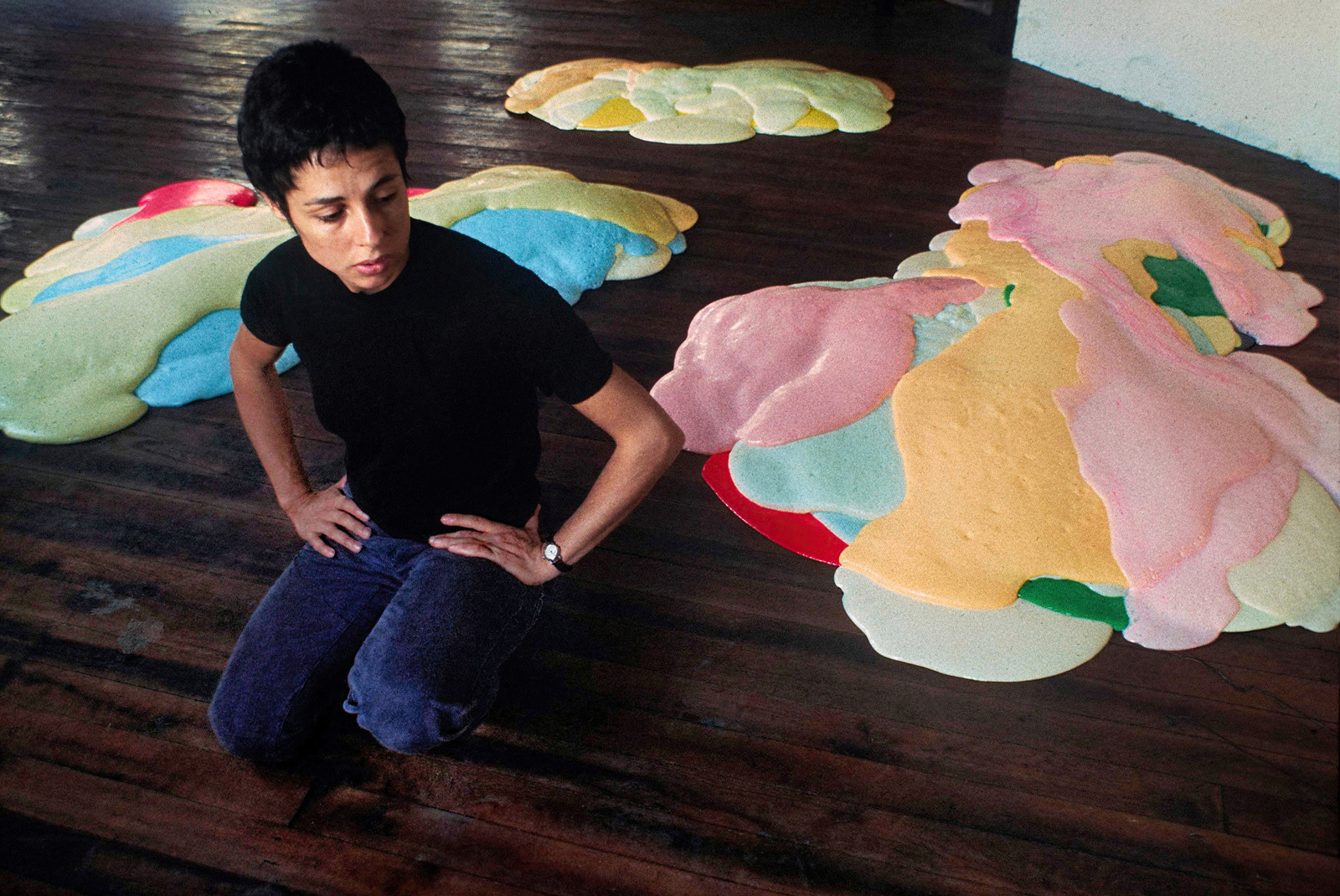
Benglis gained wider recognition from the late 1960s onward with her so-called pours. For these, she mixed latex with fluorescent pigments and poured the mixture directly onto the floor. By rejecting canvas, stretcher, and brush, she radically redefined what a painting could be. Around the same time, she began pouring viscous pigmented polyurethane foam onto the floor, into corners of rooms, or over wire mesh. This gave rise to a series of cantilevered foam installations whose monumental elements seem to ooze and spill directly out of the wall. Among them is her now-iconic, glow-in-the-dark Phantom (1971), the only installation of the series that survives today. On view in Basel, it will be seen publicly for the first time in Europe.
Benglis’s early polyurethane works were followed by her knotted sculptures. Beginning in 1972, she created these works from wire mesh, cotton fabric, and plaster, finishing them with glitter, or later coating them with aerosolized metal. Their shimmering surfaces openly embrace embellishment and an ostentatious excess at odds with the aesthetics of the art that was being celebrated at the time. Photography, working with the media, and video also became integral to Benglis’s early practice. These works combine performative actions with technological experiments and examine questions of physical presence, sexuality, and gender. She continued this exploration with a much-discussed artwork that appeared as an advertisement in the art magazine Artforum in 1974. For it, Benglis provocatively seized control of her own image, challenging prevailing assumptions about authorship, sexuality, gender, and artistic identity in a male-dominated art world.
Benglis’s restless experimentation continues to this day. This is evident in her more recent ceramics or striking, monumental sculptures such as Power Tower from 2019. For more than six decades, her work has been shaped by an uncompromising exploration of the intersections between material, embodied experience, and physical sensation. It resonates with discourses on feminism and ecology and has inspired numerous artists. The extent to which Benglis’s œuvre remains formative even beyond the visual arts is evident in Dior’s latest haute couture collection, for which Creative Director Jonathan Anderson directly references individual works by the artist.
A catalog will be published by Tate Publishing, bringing together newly commissioned essays by Jordan Carter, Elena Filipovic, David Getsy, Susan Richmond, Len Schaller, and Catherine Wood, along with an extensive chronology and numerous illustrations.
"Lynda Benglis" is organized by the Kunstmuseum Basel, in collaboration with Tate Modern, London, and the Louisiana Museum of Modern Art, Humlebæk.