Alice Bailly
Experiments in Color
Nineteen prints by Alice Bailly (1872–1938) from the collection of the Kunstmuseum Basel’s Kupferstichkabinett (Department of Prints and Drawings) are on display in the museum’s graphic art galleries. The Geneva-born artist is known today for her paintings and wool pictures; in the early years of her career, however, she mostly produced prints—specifically, woodcuts—and experimented with different combinations of colors. The presentation is rounded out by prints by other artists who, like Bailly, experimented with color and captured similar impressions, including the Frenchmen Pierre Bonnard (1867–1947) and Édouard Vuillard (1868–1949) as well as the Swiss artists Cuno Amiet (1868–1961), Hannah Egger (1881–1965), and Félix Vallotton (1865–1925).
Alice Bailly kickstarted her career as an artist in 1904, when she was thirty-two years old. She was visiting the Valais, which was then regarded as a sanctuary of unspoiled nature by the residents of Switzerland’s urban centers. Bailly traveled by way of Sion to the Val d’Hérens, where she made sketches of the landscape and people. These served as the basis for her first woodcuts, which she produced later that same year after returning to Geneva. She was initially inspired by Félix Vallotton‘s prints with their clearly defined areas of black contrasting with the white paper.
In 1906, Bailly moved to Paris, where she began experimenting with different colors. Using the same woodblocks, she created a colorful version and one in shades of gray. Bailly returned to her Valais motifs, hoping that these rural scenes would appeal to an urban audience. The different versions were meant to encourage collectors to purchase multiple prints at once.
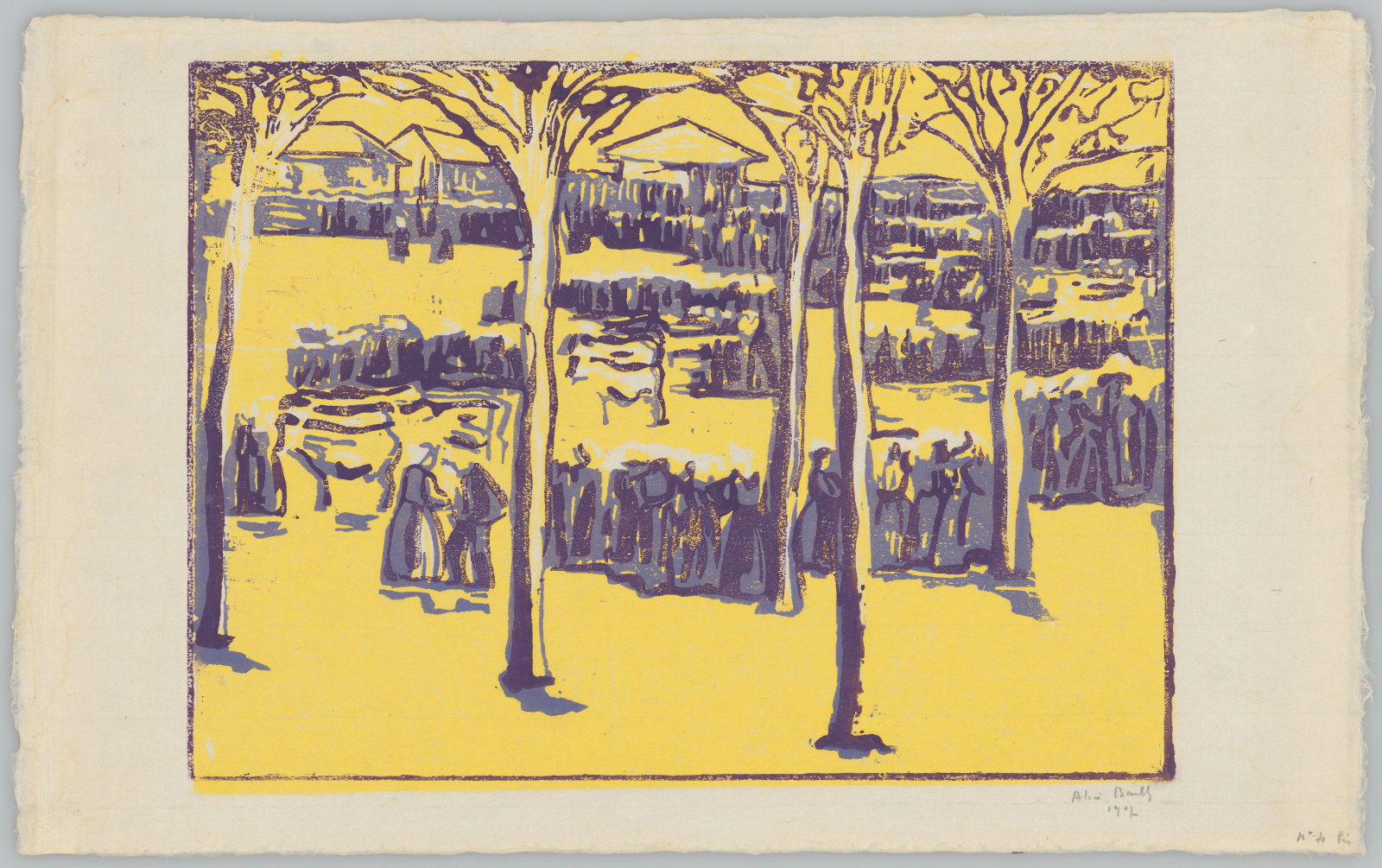
In her next series (1906–07), Bailly dedicated herself to motifs from her surroundings in Paris. In these works, too, she experimented with the color palette and produced variations in grayscale. Yet she also played with sophisticated nuances of color, as the two versions of Petites filles au Luxembourg (1907) illustrate. The scenes in Paris parks are reminiscent of the popular lithographic series by the French artists Édouard Vuillard (1868–1940) and Pierre Bonnard (1867–1947), which capture life in the streets of the metropolis. Once more, Bailly chose a subject with which she could hope to generate income.
In 1907, Bailly undertook her first trip to Brittany, which sparked a third series of color woodcuts (1907–08). The region’s traditional culture fascinated a wide variety of artists, including Émile Bernard (1868–1941) and the Swiss Cuno Amiet (1868–1961), who traveled there in 1892. Besides the Breton motifs, Bailly’s prints have little in common with those of Amiet and Bernard: She drew inspiration for her woodcuts from Fauvism, a movement known for its bold and non-mimetic colors. In Marché breton (1907), she composed a market scene in yellow, blue, and purple, altogether abandoning the naturalistic palette.
After her print series from Brittany, the artist did not return to woodcuts until 1914, when she found herself unexpectedly stranded in Switzerland due to the outbreak of World War I. Having explored Cubism, Fauvism, and Futurism in Paris, she now took an interest in the Dada movement and began to forge her own mode of expression.
The exhibition in the print galleries features nineteen woodcuts by Alice Bailly created between 1904 and 1923. Thirteen of the works on paper on display have been in the Kupferstichkabinett’s collection since 1913 and 1916, respectively; they were donated to the museum by the Friends of the Kupferstichkabinett, who had purchased the works directly from the artist. The holdings were enlarged by additional acquisitions in 1916 and 1966, a gift from the Swiss Graphic Arts Society in 1924, and two more works given by a private donor in 2023.